Skull Horde (2026) review
Infernal inspiration.

At this point, more than a few games have tried to fuse together the frictionless thrill of Vampire Survivors with the dark fantasy tropes of Diablo. Halls of Torment, Tower of Babel, and Conquest Dark all fall into this nascent niche and it's all too likely there even more than I don’t know about.
Skull Horde fits neatly into this corner of the Survivors-like subgenre, but distinguishes itself by with a greater appreciation for minon-heavy archetypes like Diablo’s Necromancer than the hack-and-slash action of the Barbarian. Despite that inspiration, there isn’t much of a story or narrative to speak of here. This is definitely one of those games that let the visuals do the talking.
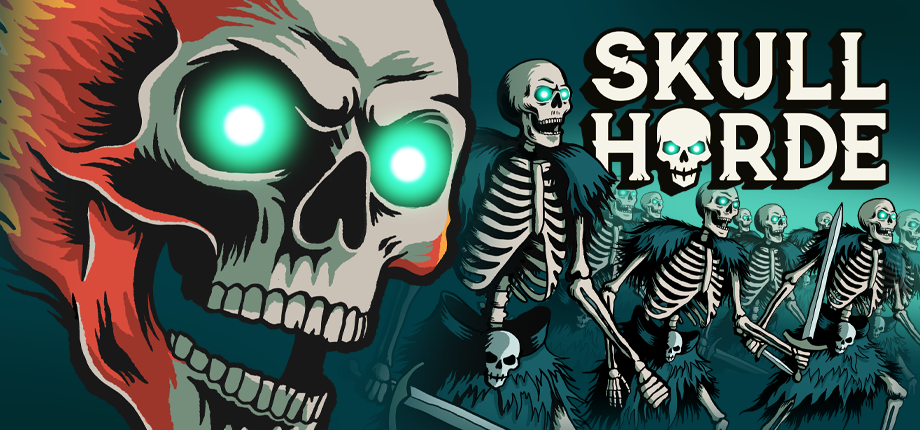
Categorically speaking, Skull Horde is a run-based dungeon crawler where you play a floating enchanted skull that commands a company of skeletons. Each run sees you complete a short of levels.
As you delve deeper into each run and defeat enemies, you’ll accrue various currencies that can be used to acquire either upgrades for your skull and other benefits for your minions writ large. Then, between levels, you can spend acquired currency to replace, upgrade and reinforce your roster of minions accordingly.
In this specific respect, Skull Horde draws on more than just Diablo. The most obvious influences here are auto-battler games like Teamfight Tactics.
Your horde is compromised of six slots, each of those slots can be filled by a different type of minion. Between levels, you get access to a shop where you can buy new minions. Some rarer or higher quality minions have synergies that make them stronger if you use them together. You can to spend in-game money upgrading the shop to make those minions more likely to appear. Finally, if you acquire stacks of the same minion, they’ll merge into a single upgraded version of that minion.
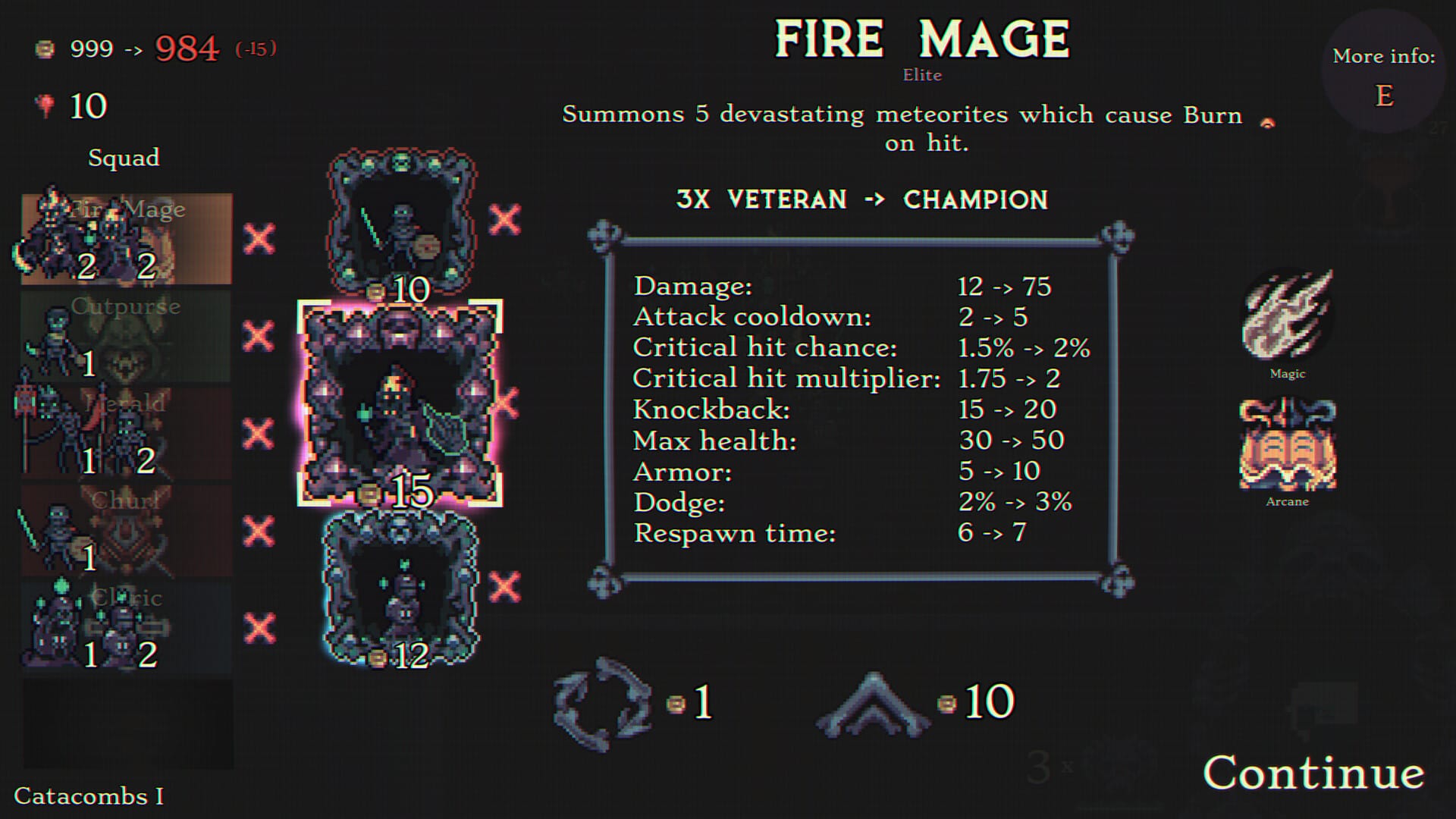
If you’ve spent much time with games like the aforementioned Teamfight Tactics, this setup will likely sound very familiar to you. However, it's far from the only thing that separates Skull Horde from the many other Survivors-likes mentioned earlier.
The game also stands out from the crowd by virtue of its crunchy pixelated graphics. The playful aesthetics in Skull Horde plays right into the ridiculousness of its premise in a way that quickly wins you over, and the subtle CRT-like distortions of the screen transitions will likely see the game stay in your good graces from there.
These elements do add up to something that is immediately enjoyable and eminently original in terms of putting a fresh spin on the familiar. Having to balance the twisting bullet hell challenge of keeping you skull safe while also thinking about the big picture strategy of your build is something that I haven’t necessarily encountered before. Unfortunately, that novelty proved shorter lived than I'd like.
While completed runs do unlock new dungeons and skulls to play to complete, your main gain for doing so is experience points. These can be used to permanently upgrade your skull with new abilities, effects and bonuses that carry between runs. There isn’t a huge amount of build diversity on offer here. It’s mostly passive bonuses and the tree itself is much smaller than those seen in Skull Horde's biggest inspirations.
For a game that is so fast to get its hooks into you, I found myself wishing Skull Horde offered just a little bit more. Across every axis where the game strikes you with a strong first impression, it quickly revealed itself to lack depth in ways that led me to tire of it. The more time I spent with Skull Horde, the more it left me unsatisfied.
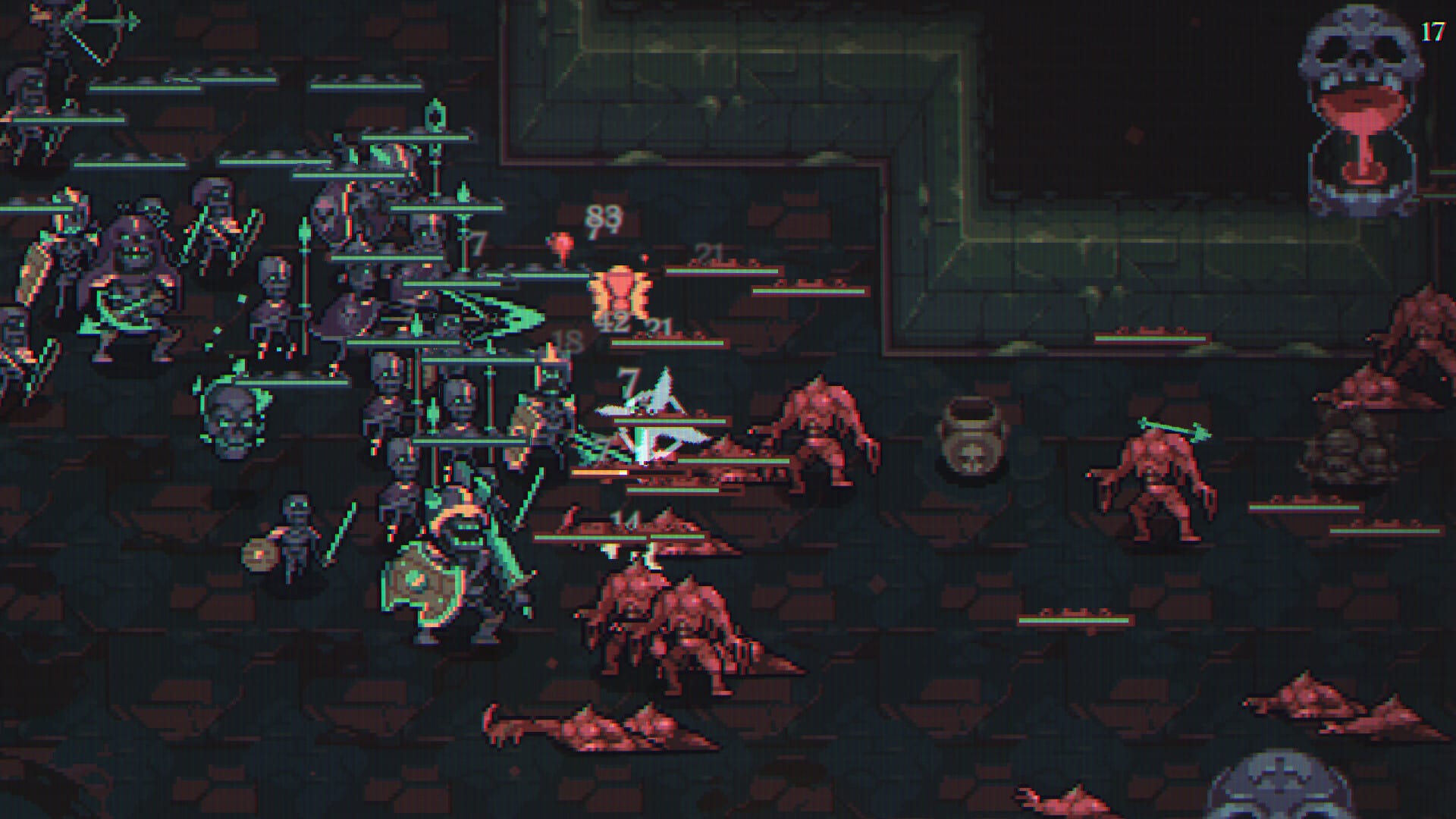
To start with, your skull has a single ability – which can be used to rally and buff your minions when needed. It’s on a very long cool-down timer and can sometimes make or break your ability to overcome a particularly difficult fight. Between uses though, there’s not a huge amount for you to do other than dodge projectiles or enemies who try to track you down. Other skulls have different abilities, but quickly run into the same problem.
Meanwhile, when it comes to minion management. I found that Skull Horde’s streamlined approach just didn’t really do it for me. I would have liked a little variety, depth or even just volume in terms of the options at my disposal. I’d clear the shop and max out my roster way too fast most of the time, and I rarely had to think about more than just the rarity of a given minion.
For as much as Skull Horde steals from the autobattler genre, it’s odd that it hasn’t inherited the strategic synergies system seen in most other iterations on that particular formula.
While the five dungeons in Skull Horde do offer escalating challenges and additional complications on the core play, the underlying procedural generation doesn’t really do much to improve or change the experience from run to run.
Most levels of most runs in most of the dungeons feel kinda the same in terms of both layout and pacing. Sometimes you’ll get an elite enemy you have to defeat to advance further. More often, it feels like you're just going through the motions. Most rooms are either empty or have a shop in them, which is rarely much of a boon because levels aren’t that long to begin with so you’re never all that far away from the chance to splash that cash.
The Bottom Line
Skull Horde nails the necromantic niche that other hack-and-slash hybrids have failed to even consider, which may make it a great fit for those who prefer to let their in-game pets do the work. It's very pick-up-and-play friendly and the aesthetic does distinguish it from its contemporaries. Even so, I can’t help but suspect it may leave those who prefer the crunchier end of things may find it an unsatisfying echo of its biggest inspirations.
If you’ve tired of your current Survivors-like of choice and are after one that puts a slightly different spin on the subgenre, then Skull Horde will likely scratch that itch. Just don’t expect it to spin any heads.