Should you read the Warhammer: Horus Heresy books?

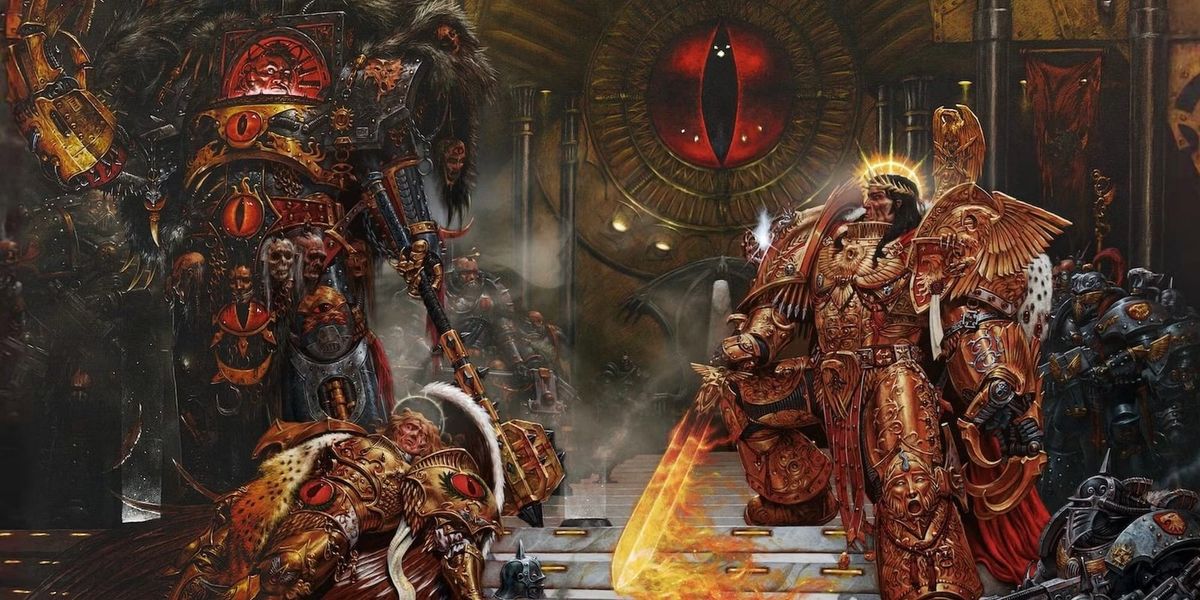
Is this 65-part prequel worth the squeeze?
I first started reading the Horus Heresy about twenty years ago, but I didn’t get very far. This sprawling space opera kicked off in 2006 with Dan Abnett’s Horus Rising. My initial attempt to hop aboard the saga would have happened maybe a year or two later. Then, in 2023, I decided to take another stab at the sprawling series.
For the unfamiliar: The Horus Heresy is a series of books that covers the civil war that leads into the grim and dark status quo of Games Workshop’s Warhammer 40,000 miniatures games. Over the course of the past forty years, the world of “Warhammer 30,000” has gone from being background lore to a book series and now its own miniatures line.
For my purposes, when I hear people talk about the Horus Heresy though - it’s usually in relation to the novels. No less than 64 additional installments of the series have been published over the past twenty years, culminating in 2024’s The Death and The End: Volume 3. Arguably, the series continues today under the new moniker of The Scouring – which follows many of the same characters and plot threads left in the aftermath of the Horus Heresy’s climax.
All this is to say that this series’ is not one for the sound of mind or the faint of heart. Much like the miniatures games attached to the franchise, it’s one for the sickos. There’s no better litmus test for this than this unofficial reading order graphic for the series.
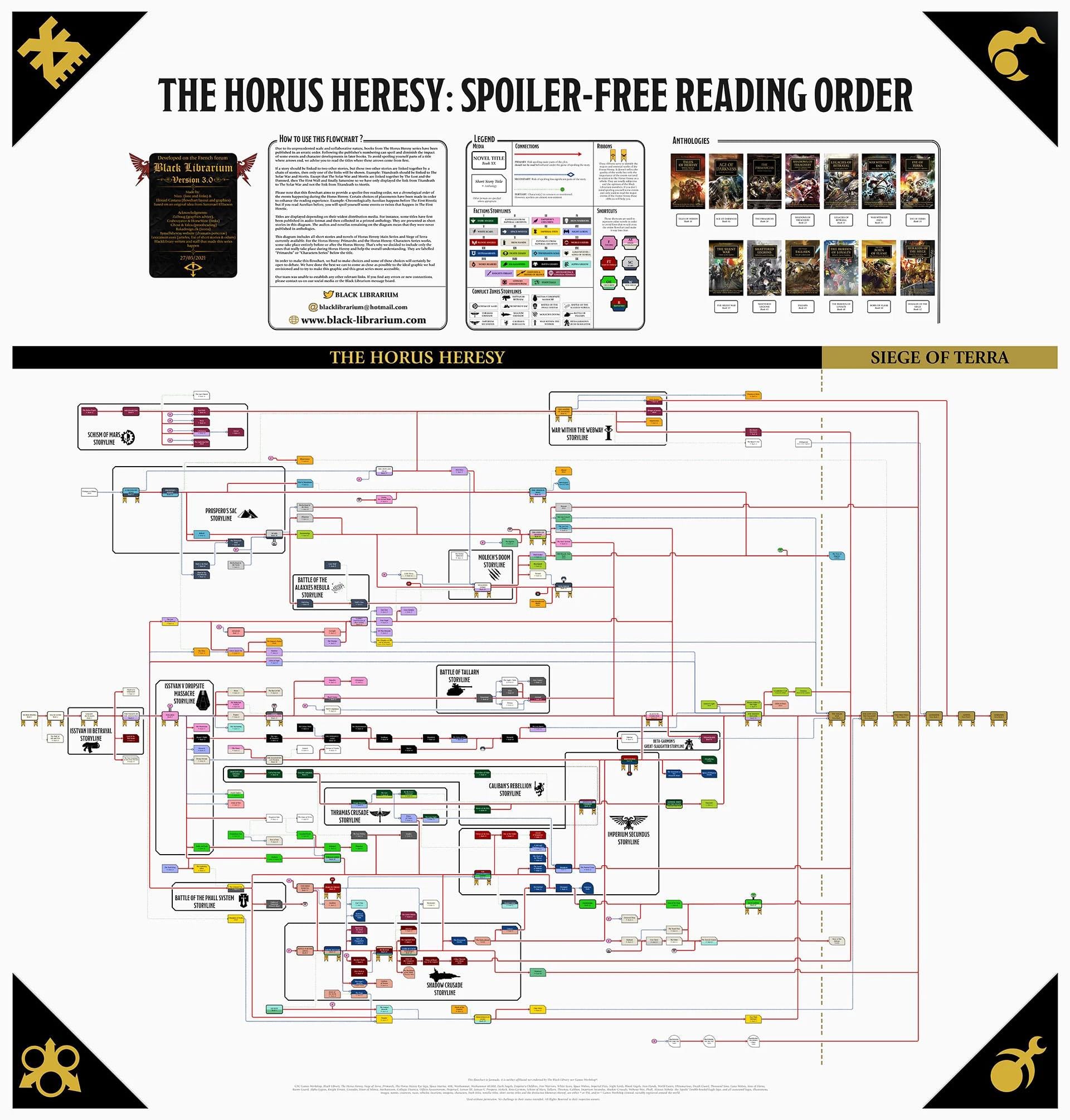
It’s all very daunting and complicated from the outside. When you get down to it though, it really is about family.
Galaxy in flames
The Horus Heresy is a series that took me years to read. However, there are some that might argue that I never read it all. The truth is that I listened to audiobooks for every installment – which are available via Audible and the Black Library website. These are really well produced and to be completely honest, I wouldn’t be shocked if that’s how most of the people who do make it through the entire Horus Heresy do so.
I can’t blame anyone for falling off the wagon though. For as strong as the opening three books – or even the first ten novels – are, the dozens that follow become increasingly disparate in terms of both their individual quality and their significance to the larger narrative.
At a meta-textual level, The Horus Heresy is a story about scope creep. It’s a prequel that explains “what happened” to the Imperium of Man seen in the world of Warhammer 40,000 and all the messy questions that entails.
The short version of this set up is that it’s the 31st millennium and the Earth is the seat of power for a godlike monarch who styles themselves as the Emperor. To help conquer the stars, the Emperor “creates” twenty sons – referred to as Primarchs. However, something goes wrong and these offspring are scattered across the stars onto various planets.
From there, the Emperor ventures out into space to collect his sons. Because Warhammer 40,000 is a very maximalist science fiction setting, there are no less than twenty of them. So the story goes, each of these children contain some measure of their father’s greatness. No matter the planet they end up on, they quickly find themselves on a trajectory towards either violence, glory or both.
Eventually, their father shows up to bring them into the fold and the crusade rolls ever onward. Standing on the front-line of this imperialist agenda are the space marines, who are genetically-enhanced warriors derived from each of the primarchs in a similar way that those sons are descended from the so-called Master of Mankind.
At a certain point, “something else happened” to two of the Primarchs. To date, Games Workshop refuses to elaborate or explain quite what the deal is but don’t worry too much. It’s not important or all that relevant to the events of The Horus Heresy, aside from the fact there are now only 18 sons of the Emperor you need to keep track of.
Anyway, some time passes. Eventually, the Emperor retires to earth to work on his hobbies and leaves one of his sons – Horus – in charge. The crusade rolls ever onward until Horus is fatally wounded by an unusual weapon. He makes a recovery, but afterwards he isn’t the same. One thing leads to another, with Horus rebelling against his father – splitting his legion of siblings right down the middle.
A seven-year civil war follows, eventually culminating in a showdown between father and son that leaves one dead, the other broken beyond repair and a galaxy-spanning empire in decline. If I was to explain the plot of The Horus Heresy, the above is usually how I’d do it. However, the main thing that’s missing from the above explanation is the sheer volume of it all.
Let’s start with our principle cast of characters. You’ve got the Emperor. You’ve got eighteen sons. Each of those sons – and the emperor – have their own supporting cast of confidants and counselors. There’s also a half dozen or so recurring characters of the more mortal variety and each book in the series also introduces a few new players and/or antagonists.
This can be a lot of information to digest, let alone grapple with. But the bigger consequence of this enormous number of characters is that it truly takes an incredible time for any given plot thread to develop into something meaningful that pulls the story forward.
Of course, the thing with the Horus Heresy is that it is not just long, it’s scattered throughout time. The order in which these books were published is not the order in which they chronologically occur. Some books move forward, others go backwards. The anthologies – which happen every eight or nine installments – usually do a little bit of both. As with most prequels, it’s often less about the destination so much as it is the journey.
The thing about The Horus Heresy is that the vast bulk of the pitch I just gave you really does just cover the first three or so books. The fifty-two that follow that initial trilogy make up the bulk of the 7-year period that the series stretches across. The final ten are branded as The Siege of Terra but are Horus Heresy novels in all but name in much the same way as The Scouring is.
Given how easily I skipped over it during the synopsis above, you might be wondering just how much happens in that 52 book run between Galaxy in Flames and The Solar War. The short answer is not a lot. The longer one requires me to talk about Gundam.
The battle rages
Not long after finishing the Horus Heresy, I found myself embarking upon the odyssey that is Mobile Suit Gundam. To aid me in my journey through the iconic but at-times incomprehensible anime franchise, I began listening to a little podcast called The Great Gundam Project. I can’t recommend it enough but the main reason that I bring it up is that there are countless episodes of Gundam where not a lot happens. Whenever this is the case, the hosts usually just rely on the simple shorthand of ‘The battle rages’.
The Horus Heresy has a lot of this phenomenon going on in it. Sometimes, there are entire books where lives are lost but very little is gained or learned. If you were to cut out all the filler, I reckon you could boil this story down to a more reasonable number of volumes. I don’t have a specific number in mind but I reckon more than ten but less than twenty.
Back when I was in it, it didn’t take very long to become clear that the series is in no hurry. If you’re reading it contemporaneously, you also have the benefit of knowing exactly how many books remain between you and the Siege of Terra at any time – which doesn’t really help.
So, if nothing happens for dozens of books at a time, why stick with it? Why read even The Horus Heresy? Why write this review? Is this a review? How do you even render a verdict about a decade’s long narrative like this one? The answer is that the story of The Horus Heresy is not really one the plot matters all that much. The final destination – the grim darkness of the 41st millennium – is always written in stone. With one or two exceptions, things can only move in that direction.
Despite this spectre of predestination, the thing that keeps you reading – or at least the thing that kept me reading – was the kaleidoscopic sense of texture to the story and world. The Horus Heresy is just as often science fiction by way of military story as it is detective story as it is period piece as it is Greek tragedy. The unprecedented volume of plot and characters in the series inevitably yields a level of variety and specificity that other science fiction stories can’t quite offer.
All this is to say the whole saga is a slow-motion train wreck and there’s no chance of the Imperium pulling itself out of that nosedive, so you may as well settle in and enjoy the spectacle. The reason there are so many books in this series is because there are so many characters and it’s easy to invent stories that fit into the nebulous window between the betrayal at Istvan and the final battle for Terra. It’s rare to see a science fiction series fully leverage the fact that space is so big a canvas for storytelling.
Of course, one of the most important wrinkles to this is that some authors are simply better than other authors and some characters are simply more interesting than other characters. I don’t want to name and shame or drag anyone in particular, but there were definitely specific authors who I felt were less engaging. There are others who can make the most one-note members of the cast sing. That’s not a shock though, any book series with this many authors naturally contains multitudes.
If I had to shortlist my favorites, here’s what I’d highlight.
- Battle for the Abyss by Ben Counter
- Nemesis by James Swallow
- A Thousand Sons by Graham McNeil
- The First Heretic by Aaron Dembski-Bowden
- Angel Exterminatus by Graham McNeil
- Betrayer by Aaron Dembski-Bowden
- Vulkan Lives by Nick Kyme
- The Unremembered Empire by Dan Abnett
- Pharos by Guy Haley
- The Master of Mankind by Aaron Dembski-Bowden
- Wolfsbane by Guy Haley
On the flipside, there are dozens of the Horus Heresy books that you could name and I could not tell you a single thing about them. Perhaps part of that might be down to the fact that I listened to them as audiobooks and often back-to-back. However, I don’t know if that’s the same thing as not enjoying them.
Sure, some of them definitely felt like chores – but for many, it felt akin to pulp fiction. The stakes don’t matter, I’m just here for the space battles, the epic speeches, the familial melodrama, and the vivid descriptions of close-quarters chainsword combat. Case in point, I can tell you approximately three things about Battle for the Abyss.
- The title refers to a big ship called the Abyss.
- It’s the start of a larger arc of books that covers the war between the Ultramarines and the Word Bearers.
- There’s a tremendous monologue where someone raises the question of whether the pain of betrayal can be quantified on a mathematical level to an unsuspecting victim before turning on them.
In large part, the reason why this book is on my shortlist is because that sudden-but-inevitable betrayal absolutely sings. Writ large, the Horus Heresy is littered with little gems like this. They might be scattered throughout the series in a way that defies chronology or plot progression, but they’re there to find for those who dare to seek them out.
It only ends once
I don’t know if I will ever read another book series as long as The Horus Heresy, but I don’t doubt I’ll continue to look for one. To me, there’s something endlessly fascinating about stories that defy the narrative structure of a more traditional ending. It’s why I like Doctor Who. It’s why I liked Homestuck. It’s why I like Gundam. It’s why I like World of Warcraft. It’s why I like Critical Role. It’s part of why I like Star Wars. I’m just broken like that.
When any story goes on for long enough, it drifts so far from conventional story structure that weird stuff starts to happen. You don’t even need to read the entire Horus Heresy saga to see that in action. The series starts with a 55-volume run, before pivoting into the further 10 books – the last three of which are technically a single story.
To be honest though, if the entire Siege of Terra sub-series was not as strong as it is then I probably wouldn’t be writing this. The Horus Heresy isn’t about the destination, but it doesn’t hurt that the tail-end of the storyline is the strongest stretch of books in the entire endeavor either.
Ultimately though, as I said before, this is a story about family. That family might consist of a megalomaniac father and his equally-fucked up warlord sons and it might be complicated by the existence of ontological evils within the cosmos, but at the end of the day it is still about the web of relationships that bind or pull each member of that family in a given direction.
The joy of the Horus Heresy is that it is a canvas upon which no amount of "if only" will ever be enough. It only ends one way, and it only ends once.