Inside LG's Dire Wolves
Why 2018 might be the year this League of Legends pro-team breaks into global contention

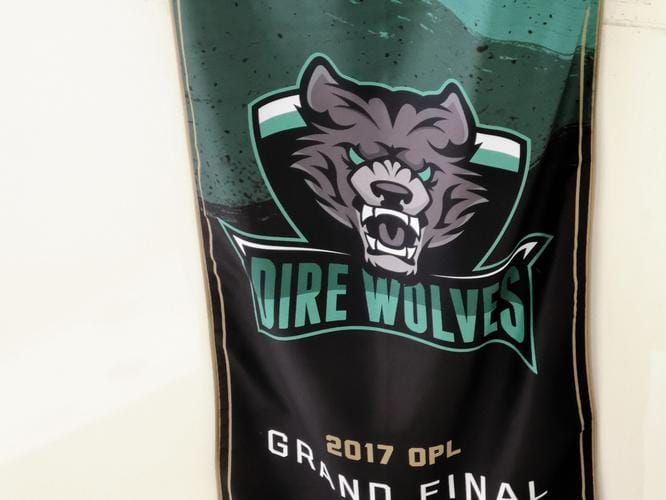
The Dire Wolves are a relatively young organisation by global esports standards but it hasn’t taken them long to amass a loyal following within the League of Legends Oceanic Pro League (OPL).
That reputation is as fierce as it is well-earned. The team have wrapped up an undefeated season of the regular OPL and they’re a favorite to emerge the victor at this year’s OPL Grand Final in Melbourne. If they do so, the Dire Wolves will be off to South Korea to represent Australia at Worlds 2018.
The annual pinnacle of League of Legends esports, last year’s Worlds attracted 60 million unique viewers and saw Samsung Galaxy walk away victorious with just shy of $2,000,000 USD in winnings.
Unfortunately, the Dire Wolves failed to find the same traction. One of the first teams to be eliminated in the international competition, they came away with just $25,000. For the team, it was a disappointing outcome but it’s not unusual one within the recent history of Australian esports.
A league of their own
If you’re one of the rare few who haven’t encountered League of Legends before, the short version is that it’s a fast-paced multiplayer strategy game where two teams of five race to destroy their opponents base while simultaneously defending their own.
At its best, it can feel like real-time version of Chess where instead of a single individual commanding a dozen units there are five players who assume control a single piece each.
The final variable here is choice. League of Legends currently boasts a combined roster of 161 champions with fresh faces added each year. Each champion has their strengths, weaknesses, abilities and limitations. There are thousands of playable combinations and every game is a fresh start.
Still, whether we’re talking about League of Legends, DOTA 2, Counter-Strike or Overwatch, there are plenty of instances where local champions have quickly found themselves outgunned on the international stage.
Dire Wolves coach Curtis ‘Sharp’ Morgan has a theory why.
“I think that is a sign that we are up and coming as a region in terms of infrastructure and stuff like that. I think as well it’s taken a while for Australian esports to have an identity.”

“Every single tournament we’ve been to, outside of Rift Rivals, we haven’t really had an identity."
"We are not going to beat a Korean team playing like the Koreans or beat an American by playing like Americans. We are going to have to beat these teams playing our way, whatever that may be.”
Morgan said that, in the past, “we haven’t really had that mindset."
“We’ve always taken inspiration from Korea. And especially last year, we used to copy a lot of the strategies from Longzhu Gaming (now known as Kingzone DragonX) – a Korean team – but I think this year we’re very much trying to form our own identity"
"I think that key figures on our team such as Cupcake and BioPanther and even Stephen (Li) to a certain extent have very unique identities.”
“As long as we play to those strengths I feel like, if we do have the opportunity to represent Oceania, we’ll have a better shot than previously.”

Formula for success
During this latest season of the Oceanic Pro League – which is the primary avenue for Australian League of Legends esports – the Dire Wolves have continued to dominate and hold their ground as the number one team within the local arena.
Morgan said there are several factors behind the team’s success.
“I feel as though Dire Wolves have been quite good at player selection. Mainly because of the relationships that me and Rippii (Nathan Mott) built over our time when we were playing.”
Currently, the team consists of five players, with co-founder and and former-member Curtis acting as the Dire Wolves’ coach.

“We had a good eye for talent and were able to see which players were like ourselves and we could see [ourselves] working with and being great talent.”
“Me and Nathan both come from different gaming backgrounds. Him, World of Warcraft, and me, Counter-Strike. And we both have very clear philosophies on gaming in general and that sort of flowed into how we approach competition, whatever game we played. So we created an really competitive environment within Dire Wolves where any player that came in was able to thrive.”
“For example, King. I saw King’s talent at an internet cafe at some random competition in Melbourne and nobody even knew he existed at that time. He became one of the most hype ADCs Oceania has ever had.”
While Morgan said the primary ingredients here come down to “a mix of the relationships that we’ve formed,” he’s quick to add that “there’s a massive element of luck that can’t be overlooked.”
The team’s current Jungler, Shern ‘Shernfire’ Tai, was originally recruited in 2014 as a substitute. He eventually left to become part of a US-based team called Vortex but was later temporarily banned from professional play after being caught ELO Boosting.
After these setbacks, Shern ended up boot-camping in South Korea at the same time as the Dire Wolves. Shern approached them about wanting to play with Dire Wolves and return to the oceanic pro-scene. They accepted.
Such boot-camps are not uncommon in the Australian esports world. There’s a simple reason why. There aren’t actually that many professional teams for teams like the Dire Wolves to scrim, or practice, against.
Morgan said that “you’re nearly obliged to do a boot-camp and especially in Oceania, say we don’t, there’s very little teams to practice against.”

Within the Oceanic Pro League, there are currently only eight professional teams who play full-time. If the Dire Wolves don’t play against worthy opponents, they won’t be able to stay game-ready and they won’t be able to get better.
“We know that if we go and do a boot camp before an event, we’ll get plenty of practice, good quality opponents. Whether or not that changes our gameplay, all the guys are coming in confident and ready to perform,” Morgan said.
Though he said boot camps are “essential”, Morgan admits that “if you were to purely talk about the changes in gameplay, there’d be very very little pre and post boot-camp.”
Even so, these sojourns also serve an important purpose when it comes to the mental and emotional health of the team.
If the Dire Wolves don’t take the opportunities presented by boot-camps and their opponents do, there’s a fear the team might start second-guessing whether they’re adequately prepared.
Morgan said “I feel like our boot camps have had a massive contribution to where we are now. I feel like especially the one we had at the start of last year - the very first Korean one we had - I think that was the one that really levelled up Dire Wolves. Without that I don’t we would have had the success that we did. That was when Shern came in and I feel like players back then – like Chippys and King and Phantiks at that time – really got a lot of learning out of that one.”
“And ever since that Korean boot-camp, there’s been less learning but that first one I feel like really set us up for success.”

Riding the wave
Of course, sometimes success can be a double-edged sword. When you keep on winning, it can become harder to catch and learn from your mistakes.
According to Andy ‘Cupcake’ van der Vyver, “it always feels like you do learn more when you have a defeat because you have that recency-bias.”
“You know exactly what to change and what went wrong so you lost the game. Sometimes, you win and you messed up and it’s not as evident. That’s why you try and get the best practice possible and we try to stay as focused on self-improvement, no matter the results.”

Andy is unique in the esports world in that he also has experience in the traditional sporting world. Such crossover isn’t unheard of, but it is rare.
“Right before I came here I was in the States on a tennis scholarship,” he explained.
“I did pre-med in the States for a year and a half. And then I came back to New Zealand, where I live, and I did a couple of years [studying] psychology and sports science.”
“I think a lot of the people coming into the esports scene at the moment don’t have experience outside of just gaming, you know. They would have either dropped out of high school or came straight from high school. I’ve done three years of uni and I’ve a lot of played high-level tennis. So having that extra perspective I think is helpful.”

Asked what his focus is this week, Andy said that “we generally have a direction that we look at as a team. Say it’s team-fighting or execution on specific picks to get really comfortable at them. I’d say this week would be execution and getting comfortable with the meta and what we thought it was.”
“We thought that ADCs were just non-viable but there’s been a couple patches lately that’s started to bring them back into the meta. So we’re just branching out on diversifying our strategies really.”
All play and no work
If you’ve always assumed that professional players in the esports world play all day, you’d be correct. But that doesn’t mean there’s no structure to it or that it’s all fun and games.
During the on-season of the OPL, the Dire Wolves play one live match a week – either on the Friday or the Saturday.

In the lead up to these games, which are filmed in Sydney’s Riot Games studio and broadcast live on Twitch, each day is broken into two blocks of scrims. The first goes from 11AM to approximately 2PM. The second goes from 3PM to about 7PM. There’s usually a break for lunch between the two. If that day-to-day sounds like a full-time job, that’s because it is.
Scrims are a critical part of keeping the Dire Wolves’ level of play as high as it is. Sticking to their regular practice schedule is a major ingredient in their formula for success.
Andy said that he enjoys scrimming against Melbourne Order the most “because I like the players on their team. They have the best personalities and they’re a really good team. Their bot-lane is super-fun to play against because it’s super volatile.”
"Chiefs is the next-best team after us, so it’s hard to look past them as a scrim opponent. They’re very decisive. Their teamfighting is very good and that’s something we’re trying to improve on.”

Other members of the team also highlighted The Chiefs as a solid scrim opponent.
According to Shern, “they’re always challenging us and we always want to win against each other. Both sides know that they want to win more than usual.”
He said that “scrims is more like practicing execution. And then when you get on-stage that’s when the real thing happens and the habits that you’ve drilled in have to come out on stage. If it doesn’t, then there’s no point in scrimming.”
“You can create bad habits or good habits. It’s all about what you want to create.”
Every member of the team we spoke to admitted that they regularly go well beyond playing in just scrims, though not always at the same time of day. Some prefer to get their solo queue time in after scrims, others prefer using it to warm up beforehand.
What’s more, some on the team don’t even own their own computer.
Dire Wolves’ newest team member – Brandon ‘BioPanther’ Alexander – doesn’t. He said that this “allows [him] to feel like I’m not living here 24/7 and like there’s a difference between home and work.”
“It just feels like a normal job, you know what I mean. I don’t want to be at work 24/7. It just keeps me clear minded and I have that separation and that’s key for me.”
Enter The BioPanther

Brandon was signed onto the Dire Wolves earlier this year after being scouted by the team’s OCS division, called the Dire Cubs. Prior to going pro, Brandon had been playing League of Legends for about eight years.
“I think a year ago, I saw the potential in it and I went for it.”
He signed up with several friends to compete in the Oceanic Open Ladder, a series of community tournaments that Riot Oceania run. Their team failed to come out on top but Brandon wasn’t deterred.
“Because it failed, everyone just wanted to do their own thing and I kept going for it,” he said.
This persistence eventually saw him noticed by and recruited for Dire Cubs before being then picked up by the Dire Wolves proper.
When asked what he thinks esports looks like in five to ten years, BioPanther is an optimist.
“I think that esports needs to be a bit more open. It needs to be franchised more and advertised more to be more mainstreamed and seen as an opportunity for people that find this enjoyable and a pathway for them. I feel as though it’s something easy to connect with as well because games [are] easy to connect to and a lot of people do play nowadays.”

He said that, like regular sports, “it’s very easy to interact with fans and interact with people who play the same game but at a higher level. It’s just more easier that way and it just takes people contributing in different ways to reach that state.”
As for where he’ll be in five to ten years, he said “I think I’ll be a coach or caster. I always liked the casting.”
“Honestly, if I had the opportunity after my career, it would be casting. I’ve always enjoyed it.”
Being Prepared
The Dire Wolves are unique in that the vast majority of their practice happens within the confines of Sydney’s Esports High Performance Center (EHPC).

Located at the Sydney Cricket Ground, the Esports High Performance Center (EHPC) is a dedicated compound filled with top-line gaming PCs and equipment supplied by the Dire Wolves sponsors: LG and HyperX.
Though they aren’t the only esports group using the center nowadays, the Dire Wolves are fast making the facility their own. The team have only moved into the new location several months ago – but it’s already rapidly being filled with paraphernalia from Dire Wolves flags, banners, merchandise and more.
There’s a dedicated room for scrims and a shared kitchen that the team congregate in during their midday lunch break. The three Oceanic Pro League trophies the team have won thus far sit in the open-cubicle meeting-room area that Morgan uses for his morning coaching sessions.

Each week is a process of refinement as Morgan works to summarize key learnings from the previous week’s match and collaborates with the team to develop a strategy for use against their next opponent.
“As I’ve gotten more experience being a coach, I’ve become less inclined to take inspiration from other regions and very much focused on what our strengths and weaknesses are as the Dire Wolves. Although I do watch the top teams in other regions, it’s very much a side-thing for me.”
“Just to try and broaden my view of the game rather than ‘that’s what these guys are doing [so] we’ve got to do that’.”
“My meetings vary morning to morning depending on what I feel like the mood is, what our levels of motivation are [and] the opponent we’re versing.”

“Earlier in the week, I’m focused on the draft, what our priorities are, what we found was strong and what we’re looking to focus on during the day in terms of very specific things.”
Curtis said that meeting are short and to the point.
“Some [are] ten minutes, some [are] twenty minutes. From my previous experiences in being a coach, I used to have long drawn-out meetings from forty minutes to an hour but at the end of the day there’s only so much information that a player can take.”
“The morning meeting should be short, sharp, concise and to the point so that players have no mental baggage going into the game.”
He describes it as collaborative approach.
“I suggest certain things and I get other people’s viewpoints and opinions and then we create and form a coherent strategy throughout the week that we can continue to execute on.”
“Getting closer to the game day, there’s less variation of what that game plan is. Purely focusing on replicating what we’ll play on-stage. Then, within the on-stage process of pick-ban, we should have done that same pick-ban the majority of the week and we usually know what each other priorities are and what we’re looking for.”

The room where it happens
For the unfamiliar: the Draft phase is a sometimes tedious, but strategically critical, part of competitive League of Legends. As mentioned, the game features over 150 different playable characters.
However, in competitive settings, only one player can assume the role of any given champion across both teams. There’s a lot of thought that goes into each champion picked and the order in which they are chosen. Every choice serves to both open up new possibilities for the team and nullify a potential threat.
On top of that, both teams also gets five bans. These act as strategic vetoes that can lock both teams out of specific characters. Bans can either by either team to sabotage or secure specific combinations of characters and team compositions.
Morgan said that “I usually call the shots and if I’m unsure I’ll say ‘what are you comfortable with. Or I’ll give suggestions and they’ll tell me what they’re comfortable with.”

Sitting in the green room known as Nami (named after the champion of the same name) during the Dire Wolves' recent match against Tectonic gave offered first-hand insight into this process.
Ahead of the draft, Morgan sketched out an outline of what he predicted their opponents would opt for and how they should respond.
As the pre-game for the first game begins, the vast majority of Morgan’s prophecies are fulfilled.Everything goes according to plan – and, despite a drawn-out mid-game, the Dire Wolves walk away winners.
The mood is positive as the team returns to the briefly returns to the room. Some snack. Others chat. Shern sprawls himself out onto the table before gradually sitting up. The team gets back to work.

Morgan works through a notepad full of shorthand notes he’s scribbled during the game. Though they won the first match, the team are surprisingly critical of their own performances. Each offers ready admissions of their own flaws and helpful insights into addressing or working around them. A few promises to address specific mistakes are made, and then the Dire Wolves are back in the studio to begin the draft for their second game against Tectonic.

The second time around, Morgan’s ban predictions are a little less accurate.
That’s seemingly more to do with where Tectonic are at than any shortcoming in the Dire Wolves' own preparation though. With their opponents at match-point, Tectonic look to be panicking. They opt for comfort picks – characters they feel good about playing – rather than strategically-sound ones.
The Dire Wolves punish that mistake harshly. They wrap up things in a brisk twenty-four minutes. Interviewed following the match, BioPanther is modest.
"We’re feeling really good, we just don’t want to think that every opponent is lesser. We’re trying to play week-by-week, but always have that long-term goal of going for finals and Worlds.”
Big Direwolf energy

When we spoke to Andy about the recent Rift Rivals event in Sydney, he described the ordeal as bittersweet.
Though the Oceanic region itself emerged triumphant at the event, the Dire Wolves didn’t. They were the only Australian team to lose their match during the evening, with the Chiefs and Legacy Esports pushing the region as a whole over the line.
He said “it was a really cool venue and the whole experience was really cool” but adds that “it was unfortunate that we only got to play one game on the day and we lost so we didn’t get to soak up the positive energy of the crowd as much as the Chiefs did.”
“I think we use it to fuel the rest of our year. We all hate losing and we haven’t lost a lot so we were really upset after that. We’re just using it as fuel. We didn’t necessarily learn a whole lot in-game but it’s good to drive us for the rest of the year.”
Shern said that there’s a real energy to playing live that bring out the best in the Dire Wolves.

“To be honest, it’s pretty goddamn boring without an audience. It’s not boring boring but it’s not the same.”
“Playing on stage is pretty cool but then playing on stage with a live audience, that’s kinda like the dream. I haven’t played in front of many people but like one day I’d like to play in front of like 100,000 people.”
According to Shern, “it takes practice and skill to be at the top level. That’s probably something that people don't understand or respect. Technique physically is the same as technique in our game. If you don’t have the right technique and mechanics, it just doesn’t work.”
Andy said much the same.
“I would say the difference lies within us not them. When we play on-stage we just bring a whole new level of focus and calm to stage and just do what we need to do.”
“Whereas throughout the week, say you have a bad sleep or you let your emotions dictate sometimes how you feel or what you’re doing. But come game day, we’re all business and we get it done.”